


The Seydelmann Cutting Drum – Material Upgrading and Product Safety
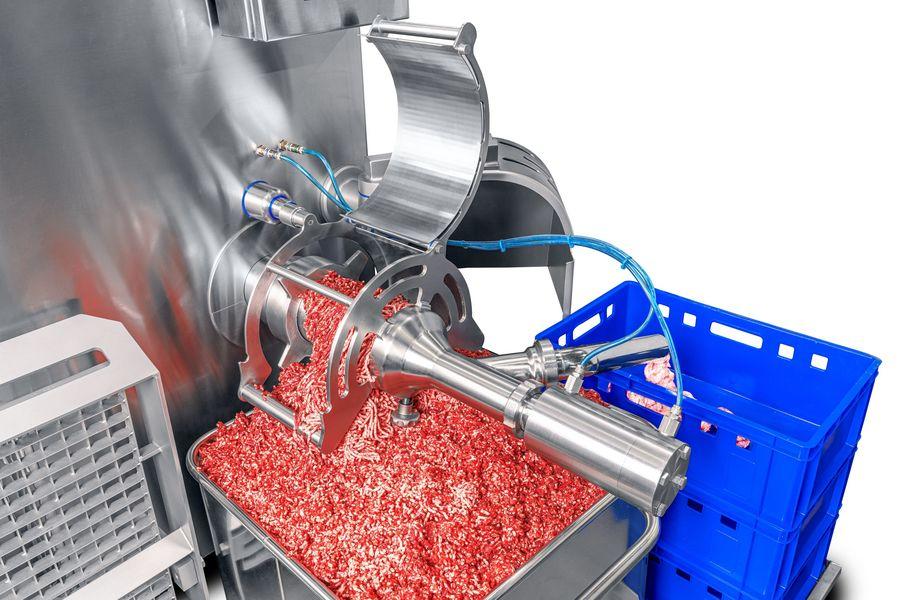
The Seydelmann cutting drum, a further development of the separation set, is a specially designed cutting system for meat grinders. It is used in place of the conventional cutting set or a separation set—consisting of grinder blades and hole plates—and significantly expands the functionality of the meat grinder.
Improvement of the separation set
The Seydelmann cutting drum, a further development of the separation set, is a specially designed cutting system for meat grinders. It is used in place of the conventional cutting set or a separation set—consisting of grinder blades and hole plates—and significantly expands the functionality of the meat grinder.
While conventional separating sets perform well in removing hard components such as tendons, cartilage, and bone fragments, they reach their limits with soft components and especially foreign objects, as the meat undergoes pre-grinding before it finally encounters the end hole plate, which is designed as a separation plate. There, all previously chopped foreign objects smaller than the holes in the final hole plate escape and are not discharged as separate.
In the cutting drum - unlike conventional separating sets - the unwanted components and foreign bodies are not further pre-ground and thus do not end up as small particles in the final product.
The cutting drum enables both the reduction of the raw material to the desired particle size and the reliable removal of unwanted components—such as connective and supporting tissue, cartilage, tendons, bone fragments, and pieces of skin and rind—in a single operation. In addition, foreign objects, such as plastic residues (splinters from E2 crates, plastic film, or even pieces of disposable gloves), can be reliably separated.
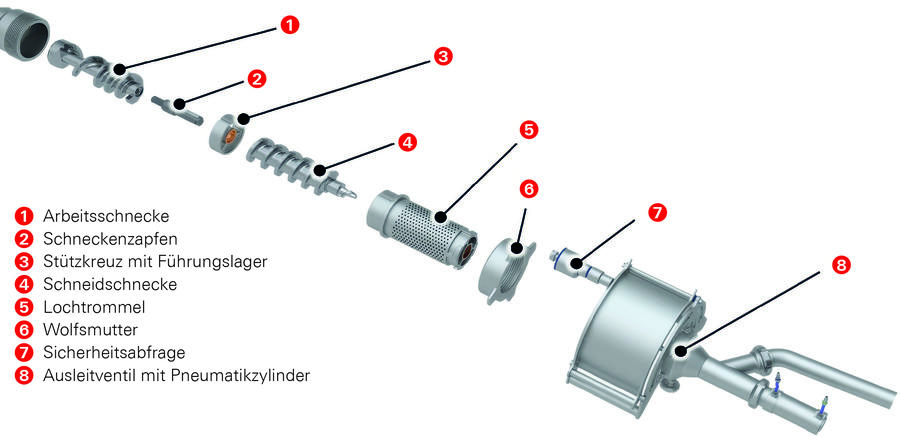
The cutting system consists of a support spacer for additional guidance, an attached cutting worm, the perforated drum, and the pneumatic discharge valve. The cutting worm presses the soft material through the holes in the perforated drum and cuts it off with the sharp edges of the worm flights only after it has entered these holes, while harder and/or tougher material—i.e., the unwanted components as well as foreign objects—is transported further toward the discharge valve and discharged there.
Product safety through foreign object separation
Due to more restrictive regulations and requirements, such as the use of packaging and protective films or the increased use of disposable gloves and plastic aprons, the risk of foreign body contamination is rising. By consistently changing the color of plastics and films from white, red, or transparent to blue, even the smallest foreign objects are visible to the consumer in the final product. Splinters from E2 crates and other plastic containers are a common source of foreign objects. Potential recalls caused by this are not only expensive but also cause enormous damage to the company’s reputation.
Processing result and cross-section like a meat grinder
Unlike with a soft separator, the raw material is not compressed. The result is high-quality ground meat with a defined, mosaic-like texture—not a pressed meat paste. Studies by the German Institute of Food Technology (DIL) have shown that the juice-holding capacity is significantly higher than with conventional cutting or separating units. This means better pH stability and thus extended shelf life, better color stability, and consequently more appealing products.
The separated components are collected and discharged in a controlled manner via a pneumatic discharge valve. In this process, the pressure of the product flow itself acts to open the pneumatic cylinder. Only when enough separate has been collected and is resting against the cylinder does the pressure rise high enough to exceed the counterpressure of the pneumatic system; as a result, the cylinder remains open until the separated product has been discharged. Subsequently, the counterpressure of the pneumatic cylinder prevails again.
Controlled foreign object separation supports operational quality and safety concepts and contributes to compliance with stringent regulatory requirements. For companies, this means greater product safety, reduced liability risk, and strengthened brand trust.
Cost-saving potential through material upgrading and material improvement
A key advantage of the cutting drum also lies in targeted material upgrading—see the example in the side note.
By separating the lean and fat fractions - a process known as defatting—the quality of the end product is significantly improved and upgraded by at least one commercial grade. In this process, a portion of the fat is separated from the raw material, resulting in leaner ground meat. Undesirable connective tissue can also be removed at the same time, though this is not always the primary focus in this case. Through this material upgrading alone, the purchase of the machine with the cutting system typically pays for itself in less than a year.
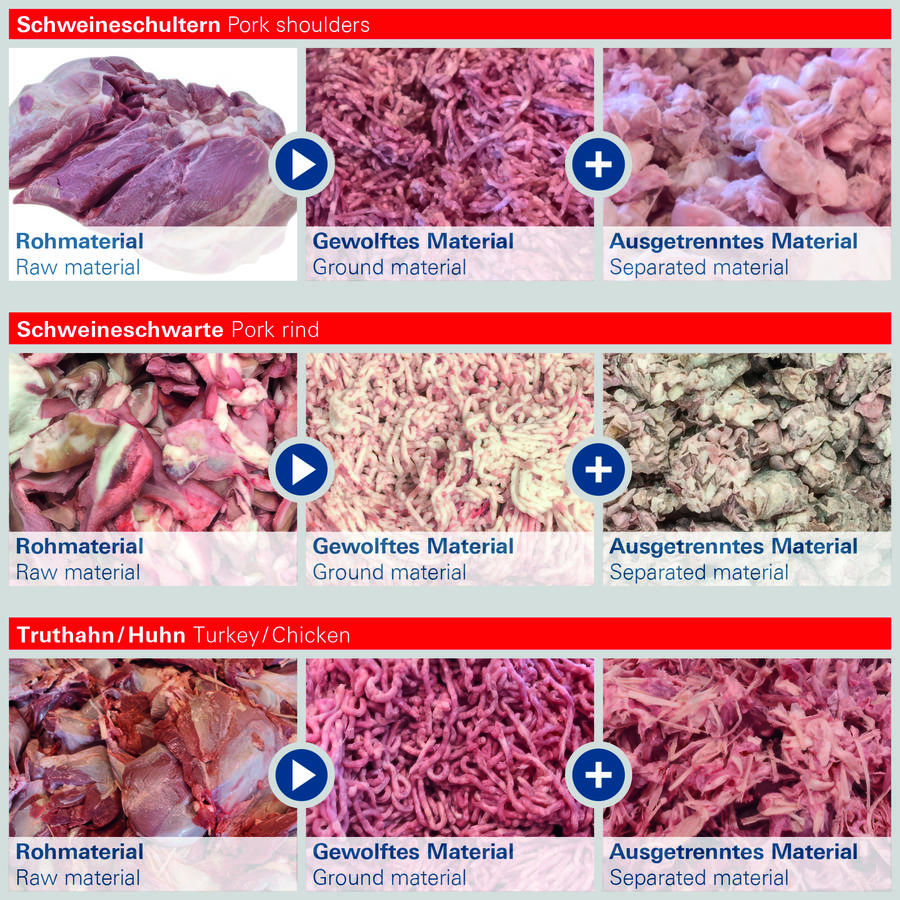
Side Note: Material Upgrading Using the Example of Pork Shoulders
The processing of whole pork shoulders, with the aim of separating the lean and fat portions (so-called defatting), takes place in two steps. In the first pass, only the lean meat is ground at low discharge pressure, while fat, cartilage, tendons, and bone fragments are separated, as are foreign particles. The recovered lean meat can now be used, for example, to produce raw sausage products.
The separated material is then passed through the cutting drum again, this time at a higher outlet pressure (back pressure) of the discharge cylinder. The pressure is set so that only the fat is ground, while hard parts and foreign particles are reliably discharged. Due to its high connective tissue content, the fat obtained in this way corresponds to the much more expensive cheek fat and is ideal for improving the binding in cooked sausages.
In addition to its use as a conventional separator or for defatting, the cutting drum also offers many other possibilities for material improvement. The following four examples illustrate successful applications:
- The removal of rind and, consequently, the extraction of fat from smaller sections that are difficult and time-consuming to process using a rind-removing machine, with the separated rind scraps themselves also being further utilized.
- Removing bile ducts from liver in preparation for liver sausage production.
- Extracting head meat or high-quality fat from whole masks—cooked or raw—while reliably separating out collagen and hard particles.
- Separation of bony tendons from turkey drumsticks during the production of ground turkey.
- Many other applications, including those outside of meat processing.
Low product stress and minimal warming
The non-contact cutting principle ensures that the raw material is processed with particular care. Mechanical stress is significantly lower than with conventional cutting sets or cutting and separating systems. Cell structures remain largely intact, product smearing is prevented, and the particle structure remains stable. This has a very positive effect on juice retention and pH stability.
In addition, energy input is very low, resulting in a temperature increase that is up to 60 percent lower than with conventional cutting or separation systems. This minimal heating protects the protein structure, preserves color and binding capacity, and creates optimal conditions for downstream processes.
Contactless cutting without metal abrasion
The system is designed to operate with a cutting worm and a perforated drum with a pneumatic discharge valve. The system operates in a meat grinder without the use of traditional cutting components such as grinder blades or hole blades. Installation is very simple and intuitive. The cutting drum is available as an option for all Seydelmann grinders in sizes E 130, G 160, and U 200.
A key technical feature of the cutting drum is the minimal distance between the cutting worm and the perforated drum. This allows the raw material to be ground without contact. Unlike conventional cutting sets, where grinding blades run directly against hole blades, there is no metal-to-metal contact and thus no abrasion, which in turn prevents metal contamination.
Metal contamination in the final product is undesirable for several reasons. First, it can lead to discoloration in sliced products due to the corrosion of metal particles, which appear unappetizing to the consumer and can be misinterpreted (blood spots). Second, the abrasion particles themselves, even if very small, can be visible, particularly in light-colored products, such as cheese. For sensitive products, contamination from metal abrasion is generally undesirable and viewed critically; think, for example, of baby food.
The contact-free design without metal abrasion significantly reduces wear and ensures very long component service life. The parts do not need to be reground until much later—service life of up to 10,000 tons is possible.
At the same time, mechanical resistance in the process is reduced due to lower friction, which has a positive effect on energy consumption, heat input, and product quality.
Higher throughput with reduced energy consumption
The perforated drum has a significantly larger surface area with more holes than a conventional end-hole blade in a meat grinder. This significantly increases the cutting and discharge area. Compared to conventional cutting or separating sets, a throughput that is approximately 15 to 20 percent higher is achieved.
Despite the increased throughput, energy consumption decreases because the material is processed with less mechanical resistance and with less friction. This combination of higher production capacity and lower energy consumption leads to a sustainable increase in operational efficiency.
Cost-efficiency and low operating costs
In addition to improving product quality, the cutting drum also delivers economic benefits. The absence of metal-to-metal contact reduces wear to a minimum, significantly lowering the need for replacement parts and maintenance costs. The long service life of the components between regrinding cycles sustainably reduces ongoing costs. The cutting drum and cutting worm can be easily reground multiple times.
Additionally, the higher throughput ensures increased productivity per unit of time. Combined with reduced energy consumption and improved raw material utilization, this results in noticeable cost savings in day-to-day production.
Opting for a cutting drum does not preclude the use of conventional cutting sets on the same meat grinder—these can still be used if the product requires it, such as when grinding fillings.
When using the cutting drum in conjunction with a Seydelmann AU 200 U Universal Grinder, the need not only for a soft separator but also for a frozen meat grinder or any flakers and frozen meat choppers is eliminated - a major advantage, as significantly less production space is required, and maintenance costs are reduced. For processing frozen meat—entire blocks down to minus 25 degrees Celsius are possible—a conventional cutting set is simply used. This results in a true 3-in-1 solution for cost-effective operation with minimal space requirements.
Conclusion:
The Seydelmann cutting drum combines product safety, material upgrading, texture-preserving grinding, reliable foreign material separation, and high cost-effectiveness in a compact attachment system for meat grinders. With contact-free cutting, minimal energy input, and increased throughput, it represents a technically mature solution. This makes it a future-oriented component for modern, quality-oriented meat processing facilities.